




Part Z

Contents |
[edit] Background
In July 2021, the construction industry proposed Part Z, an amendment to the UK building regulations to regulate embodied carbon on all major construction projects. The amendment, if introduced (currently only an industry proposal, and not backed by government),would require whole life carbon assessments and compliance with embodied carbon limits for projects greater than 1000m2 (or 10 dwellings). The proposal was publicly launched in Westminster in March 2022.,
The proposal was written by 5 construction industry professionals: Will Arnold (Head of Climate Action at the Institution of Structural Engineers), Tim den Dekker (Associate Architect at Feilden Clegg Bradley Studios), Dr Jannik Giesekam (Research Fellow at the University of Strathclyde), Dr Julie Godefroy (Head of Sustainability, Chartered Institution of Building Services Engineers and London Energy Transformation Initiative) and Simon Sturgis (Architect, Carbon Consultant, Royal Institute of British Architects & Royal Institution of Chartered Surveyors).
The principle of introducing embodied carbon regulations is supported by over 150 leading organisations involved in the UK building industry (statements available at https://part-z.uk/industry-support). These include The Institution of Civil Engineers (ICE), The Chartered Institution of Building Services Engineers (CIBSE), Chartered Institute Of Building (CIOB), The Institution of Structural Engineers (IStructE), The Royal Institute of British Architects (RIBA), The Royal Town Planning Institute (RTPI), The Steel Construction Institute (SCI), The Structural Timber Association (STA), UK Green Building Council(UKGBC), Off-Site Homes Alliance (OSHA), Construction Industry Council (CIC), along with many others and numerous leading firms.
For more information see https://part-z.uk/
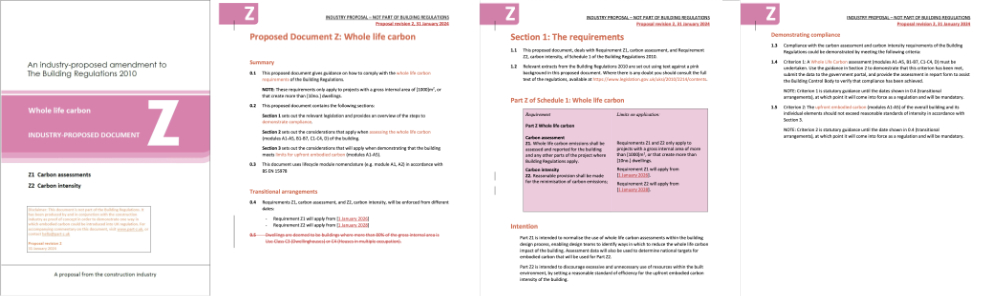
[edit] With the Net Zero Carbon Buildings Standard is Part Z still needed?
The Net Zero Carbon Buildings Standard (NZCBS), launched in September 2024, was developed by experts across the UK construction industry to provide a consistent, science-based definition of net zero carbon for buildings. It establishes asset-level requirements covering embodied carbon, operational energy, renewable energy generation, and more, all aligned with the UK’s 1.5°C carbon budget under the Paris Agreement. The Standard applies across new builds, retrofits, and existing buildings in major sectors such as housing, offices, hotels, and leisure. To be classified as a ‘Net Zero Carbon Aligned Building,’ projects must meet all mandatory thresholds set by the Standard.
Although comprehensive, the NZCBS is voluntary, meaning it relies on industry uptake rather than regulation. This is where Part Z remains essential. While both NZCBS and Part Z share alignment in requiring upfront carbon limits, whole life carbon reporting, and recognised assessment methodologies (such as the RICS framework), Part Z’s role is to make such requirements mandatory through regulation. At present, only operational energy is regulated, leaving embodied carbon unaddressed despite its significant impact. Therefore, while NZCBS sets best practice limits based on real project data, Part Z is still needed to ensure consistency and enforcement across the construction industry.
For more information see https://www.nzcbuildings.co.uk/
[edit] CIAT
CIAT endorses proposed 'Part Z' embodied carbon Building Regulations
The Chartered Institute of Architectural Technologists (CIAT) has today announced its support for regulation of embodied or ‘whole life’ carbon in construction, through the proposed 'Part Z' Building Regulations, as an essential step to delivering a net zero built environment sector.
As the global qualifying body in Architectural Technology, CIAT is committed to considering, and mitigating where possible, the impact of the Institute's actions and those of its members and affiliates on climate change.
The 'Part Z' Regulations are an industry-proposed amendment to The Building Regulations 2010, which would require developers to assess and report on the emissions embodied in the construction of a new building, and would allow for limits to be set on those embodied emissions, which could be ratcheted down over time, as low-carbon materials and processes improve.
President Eddie Weir PCIAT, said:
"I’m delighted that CIAT has joined the many other industry bodies already supporting the campaign for 'Part Z'.
"Architectural Technology is all about creating buildings that perform to the highest standards, meeting the needs of people and planet. Building Regulations set requirements for the in-use performance of buildings, but 'embodied' emissions make up an increasingly large share of the climate impact of a building over its lifetime. This is a huge gap, and closing it is essential to achieving the emissions reductions we need to see in the built environment sector over the coming 25 years.
"Chartered Architectural Technologists work tirelessly with clients and professional colleagues across the sector to deliver the best performing, most sustainable buildings possible. Until 'Part Z' is established as a regulatory requirement, I encourage our members and affiliates to do all they can to minimise embodied carbon in the buildings they design."
Chis Halligan MCIAT, Chair of the CIAT Climate Society, said:
"The decisions we make over the next few years will have a profound impact on our climate, our communities and our wellbeing for decades, perhaps centuries, to come.
"We know we need to reduce the emissions associated with construction; if cement were a country, its carbon emissions would be third only to the USA and China.
"But to deliver the best outcomes we need to go further, embedding sustainability as a design objective from the outset, rather than treating it as a bolt-on or optional extra. That way, we can deliver buildings which stand the test of time, tread lightly upon the planet, and deliver safety and resilience for building users and wider communities.
"'Part Z' only addresses embodied carbon, but by forcing designers and developers to consider sustainability from the outset, it can help raise ambitions across the sector, driving lasting change and preventing a race to the bottom. That means it’s a great place to start."
[edit] CIOB
CIOB supports proposals for a 'Part Z'
CIOB has confirmed its support for a proposed amendment to the UK Building Regulations 2010 to create an Approved Document Z requiring the assessment of whole life carbon emissions, and limiting of embodied carbon emissions, for all major building projects.
The proposal introduces mandatory assessments ahead of setting carbon limits, giving time to converge on robust yet ambitious targets.
The ‘Part Z’ amendment has been drafted by industry sustainability experts and builds off existing industry guidance, providing policymakers with a quick solution to tackling built environment industry emissions. By setting limits, rather than setting specific requirements on individual elements, the flexibility to design the most appropriate solution for each brief is retained, but now with resource use given an equal footing with cost, quality and time.
Caroline Gumble, Chief Executive Officer at CIOB, said on the proposal: “Sustainability and the push to achieve net zerohave, quite rightly, taken their place as priorities in construction.
“CIOB is supportive of regulatory moves which enable a focus on embodied carbon, not just operational carbon emissions, and add weight to its consideration as part of the construction and development process. Sustainability is already something which informs much of our work - and will for years to come - and we have been clear to our members that opportunities to take a more environment-centred approach, combined with practical measures and clarity in legislative requirements, should be welcomed. The industry needs to walk the walk on minimising climate change, not just talk the talk, and we expect CIOBmembers to update their knowledge through CPD and understand how they can make a meaningful positive contribution to achieving net zero.”
Text taken from CIOB Policy and Public Affairs Newsletter - April 2022 for more information about CIOB visit
[edit] Related articles on Designing Buildings
- Climate Emergency Design Guide.
- CIOB supports part Z proposal.
- Embodied carbon.
- Incidental room heat gains.
- Industry proposes building regulations part Z.
- LETI publishes Climate Emergency Retrofit Guide.
- Low-carbon industrial product.
- Net zero carbon 2050.
- PHribbon tool calculates embodied carbon of designs.
- Retrofit.
- Sustainable development.
- Sustainable materials.
- Sustainable procurement.
- Sustainable urban drainage systems.
- Sustainability appraisal.
- Sustainability aspirations.
- Sustainability in building design and construction.
- Sustainability in facility management.
- The Carbon Plan: Delivering our low carbon future.
- The Net Zero Carbon Buildings Standard and the proposed Part Z.
- The sustainability of construction works.
- The UK Net Zero Carbon Buildings Standard: creating a true pathway to the future.
- UK’s first net zero carbon buildings standard.
- UK net zero carbon buildings standard launch.
- UK Net Zero Carbon Buildings Standard coalition call for evidence.
- Upfront emissions.
- Zero carbon balance.
- Zero carbon homes.
- Zero carbon non-domestic buildings,
[edit] External links
https://part-z.uk/blog/the-net-zero-carbon-buildings-standard-and-what-it-means-for-part-z.
https://assets.publishing.service.gov.uk/media/602cef1d8fa8f5038595091b/National_design_guide.pdf
Featured articles
Check out some of the best features and news from Designing Buildings as well as key stories from around the web.
Introduction to radon awareness

New technical information sheet published by CIOB.

Updated supplier guide can help electrical contractors engage with NHP.

CIAT confirm the winners of the 2026 architectural technology awards.

Government launches a one stop shop for flood preparedness.

Sir Edwin Lutyens: Britain's greatest architect? Book review.

CIOB publishes free template to help assess and manage risks.
ECA's reflections on Party Conference season

Burnham wants to be confident of winning before asking for a fresh mandate.
New Chief Construction and Scientific Adviser

Sergio Cavalaro, Professor of Infrastructure Systems at Loughborough University.
Building safety levy for England

CIAT publish estimator tool for members.

Water sector faces a growing crisis that could slow the delivery of vital infrastructure.
Undervaluing our industrial past

Heritage value changes as taste for building styles changes.
Changing expectations around competence and compliance

New information sheet from CIAT.